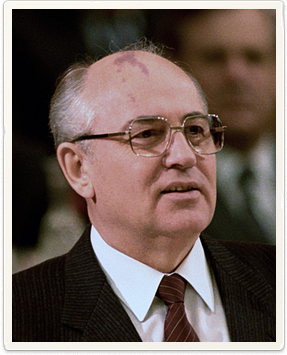
Soviet leader Gorbachev was instrumental in the collapse of Communism. He realised that his country could no longer sustain the huge economic drain of the Arms Race. The end of the Cold War began when he instigated the policies of Perestroika (economic restructuring) and Glasnost (openness) which included the formal meeting of East and West.
He met US president Reagan in Geneva (1985) and Reykjavik (1986) to agree reductions in both sides' nuclear weapons. They signed an important treaty (INF) which led to both sides agreeing to destroy a range of nuclear weapons.
But Gorbachev did not necessarily have the support of all his government ministers. Many hard-liners were horrified by his policies and blamed him for the disintegration of the USSR, which they believed he had done nothing to prevent.
In August 1991, they tried to overthrow Gorbachev. The coup failed and the Communist Party was outlawed. On Christmas Day 1991, Gorbachev resigned as leader.

